Sep 29,2026
Changzhou Huake Polymers Co., Ltd.
Official Launch of the 3rd-Generation UPR®
Huake Polymer officially releases its 3rd-generation UPR resin.
Pungent odors, frequently excessive VOC levels, repeated inquiries about flash points during fire safety inspections, and difficulties recruiting and retaining workshop employees. These are common scenarios in composite molding workshops. Behind these challenges often lies one culprit: styrene contained in resin.
Unsaturated Polyester Resin (UPR) has evolved into its third generation. This iteration is not merely about performance enhancement; it embodies a new attitude toward workers, workshops and the environment.

01 The Underestimated Variable: Styrene
Styrene is the most prevalent reactive diluent in UPR. It thins resin, enables sufficient wet-out of glass fiber, and accelerates curing. Featuring favorable processability and controllable costs, it has become the default option across the industry.
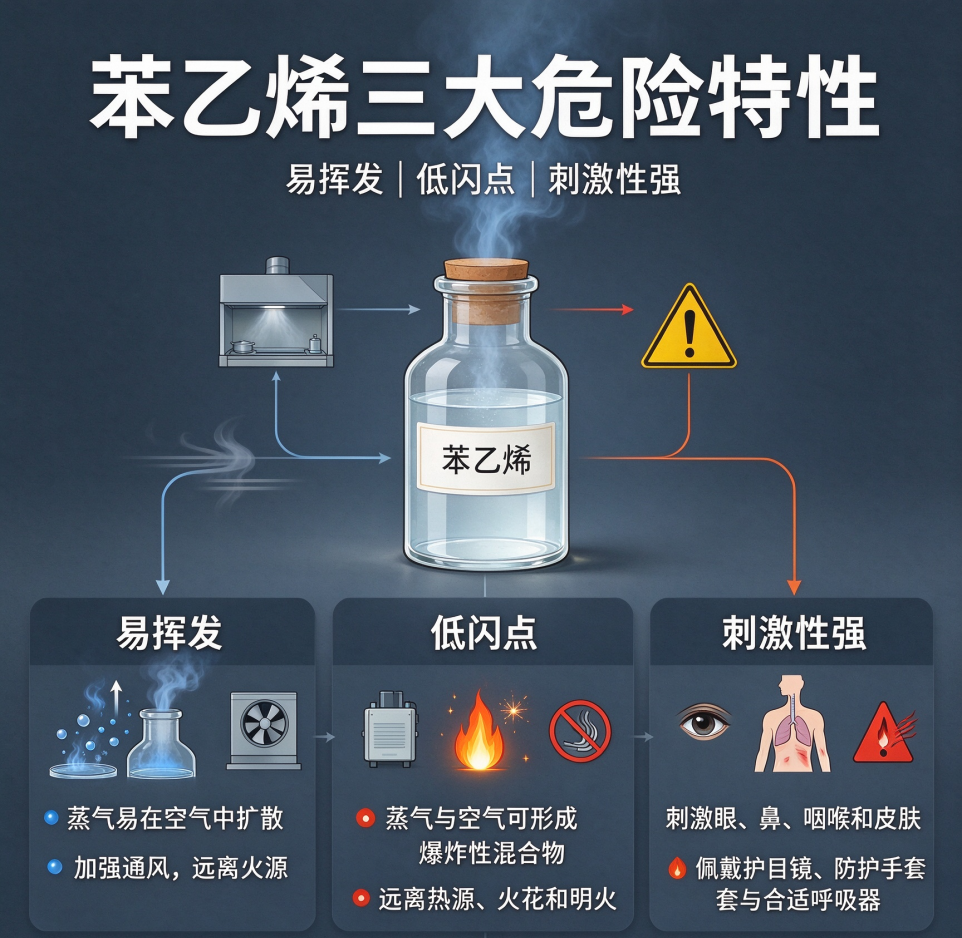
Three Major Hazardous Properties of Styrene
Driving Industry Transformation
The convenience brought by styrene comes at a hidden cost: a triple burden of environmental compliance, work safety and occupational health. This triple pressure is accelerating the upgrading of the entire industry.
02 What Is the 3rd-Generation UPR Actually Upgrading?
Many assume UPR upgrades focus on performance doubling. In fact, the core evolution of three generations lies in synchronous upgrades of production methodology, safety and environmental protection.
Evolution of Three Generations of UPR
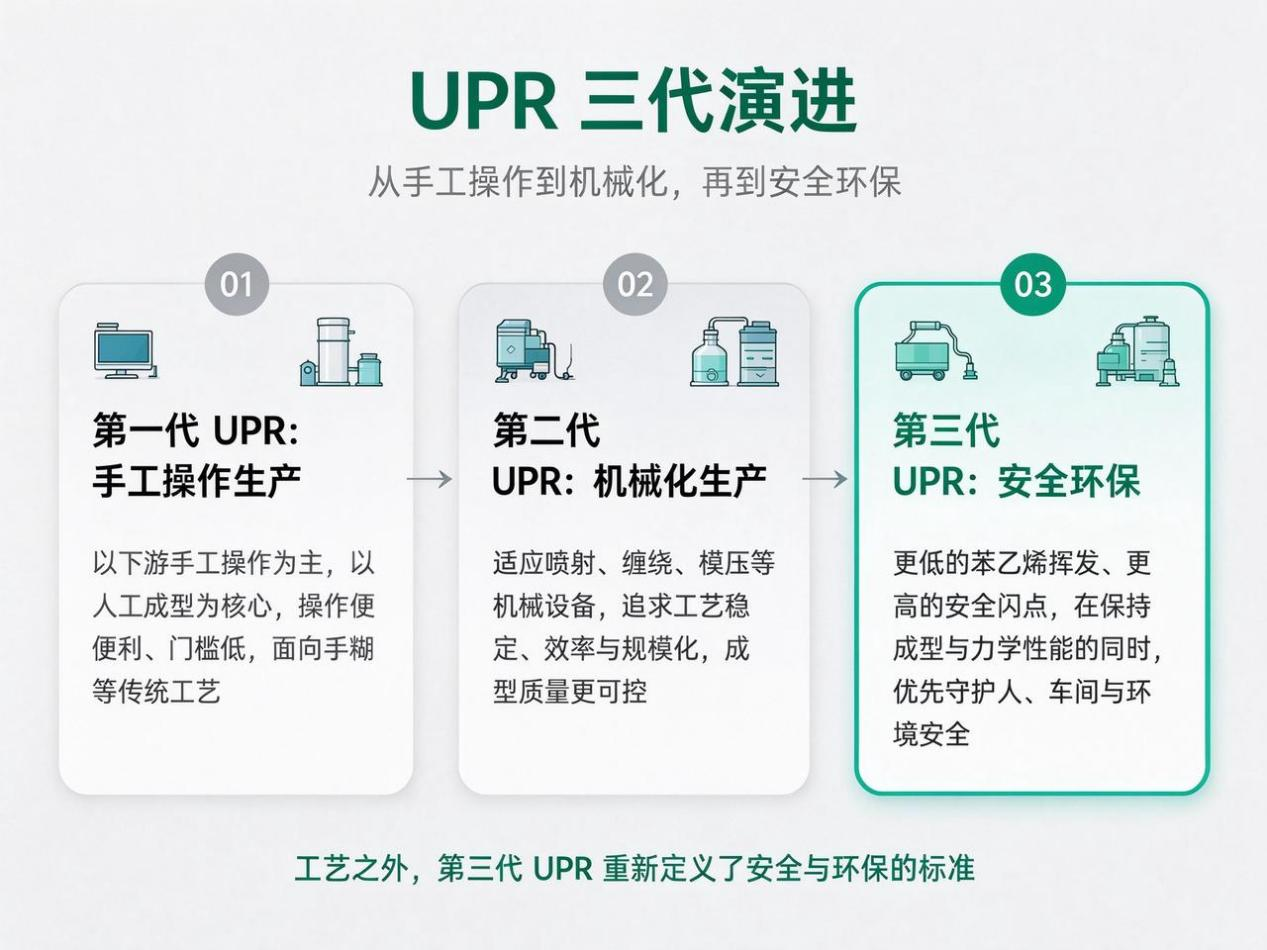
1st-Generation UPR: Manual-operation-centered production. Relying heavily on manual layup, it features low barriers and high flexibility, yet product quality and efficiency are highly manpower-dependent.
2nd-Generation UPR: Developed for mechanized production. Adaptable to spray-up, filament winding, compression molding, pultrusion and other equipment. It prioritizes stable processes, efficiency and scale production for better controllability of finished part quality.
3rd-Generation UPR: Built with safety and environmental protection embedded into product definition. It delivers reduced styrene volatilization and elevated safety flash points. While maintaining molding and mechanical properties, it prioritizes mitigation of workshop odor, VOC emissions and fire hazards.
In short:
03 The 3rd-Generation UPR: Addressing Core Industry Pain Points
3rd-Generation UPR: Four Key Industry Challenges Addressed
Stringent Environmental Compliance | Workshop Safety Risks
Odor & Labor Retention | Green Procurement Trends
Pain Point 1: Increasingly stringent environmental compliance requirements
The Emission Standard of Pollutants for Synthetic Resin Industry (GB 31572—2015, including 2024 Amendment) continuously tightens limits for styrene and other indicators. VOC emission standards for FRP and resin products keep getting stricter. Starting January 2027, the VOCs environmental protection tax pilot will be implemented, with full-emission sources including raw materials, storage and equipment sealing points incorporated into tax calculation.
The Occupational Exposure Limits for Hazardous Agents in the Workplace (GBZ 2.1) also specifies clear limits for workplace styrene concentration. Low-volatility resins cut compliance and tax costs from the source.
Pain Point 2: Workshop safety cannot rely on luck
Resins with low flash points carry higher fire and explosion risks. Lower volatilization and higher flash points add an extra safety layer for workshops.
Pain Point 3: Labor shortage threatens production capacity
Strong odor and high irritancy are hidden causes of recruitment difficulty and high turnover. Improving working environment is also critical for stable delivery capacity.
Pain Point 4: A growing number of end customers incorporate environmental protection and low volatility into supplier qualification criteria. Overseas projects even set low VOC as the threshold for procurement.
Industry statistics show that the global styrene-free resin market reached approximately USD 1.269 billion in 2025, and is projected to grow to USD 1.810 billion by 2031, with a CAGR of 6.1%. Green resin has become a key scoring item for winning orders.
Two Core Advantages of 3rd-Generation UPR
All benefits are achieved without compromising molding and mechanical performance. It is not trading performance for environmental protection, but equivalent performance with greater peace of mind.
04 Styrene-Free Resin: Huake’s Solution
If the 3rd-generation UPR minimizes problems caused by styrene, styrene-free resin eliminates styrene entirely from formulation. It replaces styrene with safer reactive diluent systems, fundamentally removing risks of styrene volatilization and flammability.
Compatible with existing curing agents and accelerators, it requires no production line modification and enables seamless substitution. This is Huake’s key product layout direction.
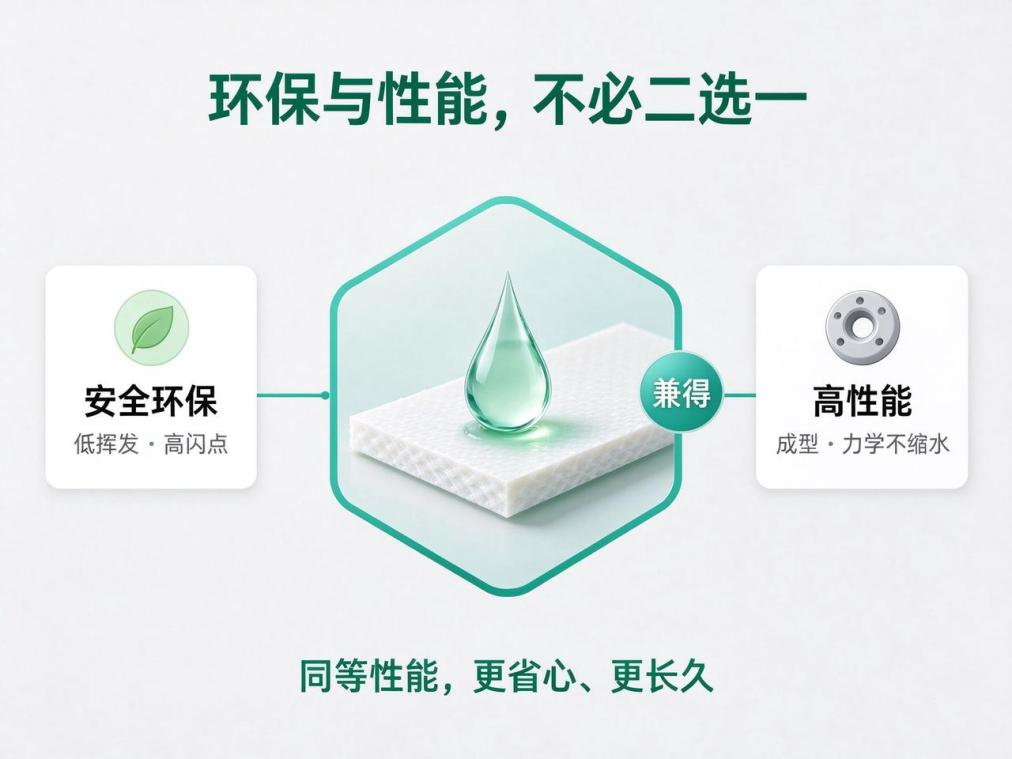
Core Advantages of Styrene-Free Resin
We can also adjust viscosity and gel time according to customer processes, and customize styrene-free resins with special properties including flame retardancy, high temperature resistance and bisphenol-A type.
05 Application Scenarios & Compatibility
From hand lay-up, spray molding, compression molding, pultrusion, RTM to CIPP pipeline rehabilitation and membrane materials, the 3rd-generation UPR and styrene-free resins cover mainstream molding processes. Whether for small-batch manual products or high-efficiency continuous production lines, matching solutions are available.
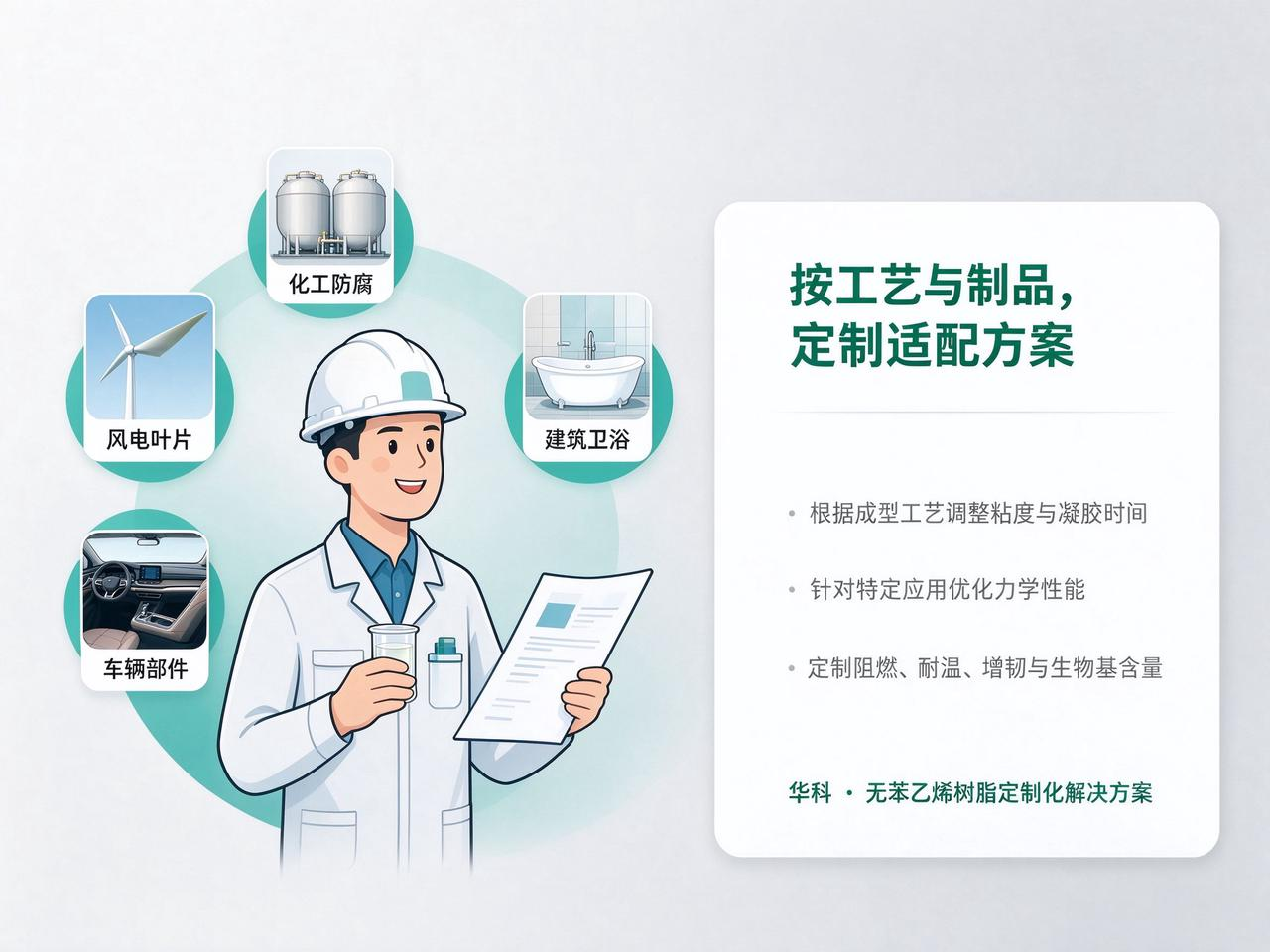
Target Industries
The iteration of UPR represents more than product upgrades. It reflects a renewed attitude toward workers, workshops and the environment.
If you are troubled by workshop odor, environmental compliance, work safety or labor recruitment, please contact us for tailored solutions.
National Service Hotline: +86-400-100-9755
Changzhou Huake Polymers Co., Ltd.
Tiktok:
Website: www.huakepolymer.com
Scan for the Styrene-Free Resin Series Product Brochure.

 EN
EN